Jacob Klaisner
1849-1883
Jacob Klaisner was the first Klaisner / Kleisner in Laurel and Lowell’s family to immigrate to the United States. He was the the uncle of US immigrants Vaclav and Joseph, the brother of their father Václav Kleisner. The genealogical chart below shows how Jacob fits into the family tree. Laurel and Lowell are 3rd cousins of Jacob’s great-grandchildren.
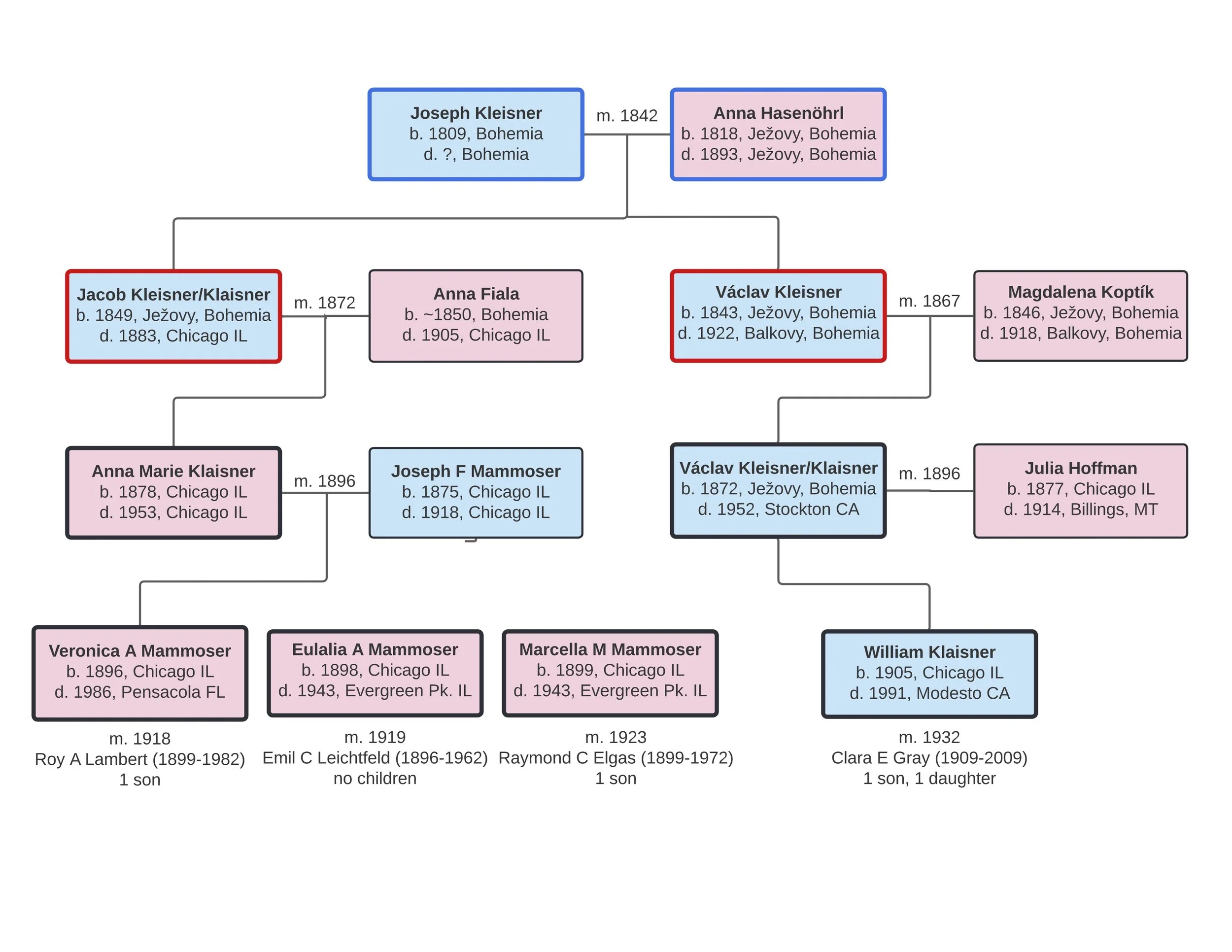
Shortly after arriving in America in 1871, Jacob Klaisner married fellow Czech immigrant Anna Fiala in Chicago. He was a cooper (barrel-maker) by trade, but eventually became a grocer, opening a store on 26th St. He and Anna had a daughter Anna Maria in 1878. Unfortunately, tragedy struck the family when in 1883 Jacob committed suicide. Anna continued to operate the grocery store for many years. Her daughter married and had three daughters, from whom there are descendants living today.
See the records and learn the full story of Jacob’s family in the sections below.
1849 Baptism
The local parish register indicates that Jacob was born on 8 July 1849 in Ježovy to Joseph Kleisner and Anna Hassenöhrl.
1849-1869: Jacob Kleisner in Bohemia
We have found the following baptismal and census records for Jacob Kleisner in Ježovy, Bohemia

Translation
8 July 1848, Ježovy No. 48 – Jacob Kleisner, son of Josef Kleisner, a cottager (smallholder), son of the late Karl Kleisner, a cottager from Přetín No. 26, and his wife Marie, née Přibík, from Lhota near Merklín.
And
Anna, daughter of Josef Hasenhorl, blacksmith and cottager from Ježovy No. 48, and his wife Kateřina, née Bayer(?) from Ježovy No. 5.
Portafontium, https://www.portafontium.eu/iipimage/34503420/soap-pj_00302_census-1869-jezovy-cp048_0020, Census 1869 Ježovy (Jeschow, Ježov), Nr. 48, image 2 of 4 : downloaded 14 Feb 2026.
1869 Census
In the Ježovy 48 household in 1869 with his parents and siblings, Jacob was listed as born in 1849 (age ~20), occupation of cooper [translation by Jan Ebert of https://www.czechancestors.com/.


Portafontium, http://www.portafontium.eu/iipimage/30070326/vreskovice-18, Roman Catholic Register Vřeskovice 18 (1829-1904), image 32 of 275 : downloaded 14 Feb 2026. Translation by Jan Kužník.
1871-1883: Jacob Klaisner in the US
We have found the following records for Jacob. His Czech surname of Kleisner was “Americanized” to Klaisner.
1880 U.S. Federal Census
As shown in this census record enumerated 11 June 1880, Jacob Klaisner and his family resided at 345 26th St in Chicago, Illinois.

Transcription
Ancestry.com. Citation, image x of y : downloaded x.
January 1883: Jacob’s Tragic End
Our cousin Jan Kužník discovered the following newspaper account of Jacob’s suicide in a Czech-language newspaper. He kindly provided the transcription and translation, as well as additional commentary.
Newspaper article: 25 Jan 1883

OldNews.com, https://www.oldnews.com/cs/record?record_id=record-12010-456733837. Pokrok Západu, Omaha, Nebraska, 25 Jan 1883, page 1 : downloaded 15 Feb 2026.
Translation
A Czech Suicide
— Once again, a Czech has taken his own life. It is Jakub Kleisner, residing at No. 345, 26th Street, Chicago. On January 18, at 2 o’clock in the afternoon, he drove a bullet into his heart and killed himself on the spot.
Jakub Kleisner operated at the said address a dairy and grocery shop. In recent times he had been very absent-minded and distracted. On January 18 he gave 75 cents to Miss Anna Rochová, who was employed by him, instructing her to go to the pharmacy to obtain Paris green. He pretended that his tenants upstairs in the house were excessively plagued by “rusy” (cockroaches) and that he wished to exterminate them with the said substance.
This matter appeared suspicious to Miss Rochová; nevertheless, she took the money, left, and shortly returned, saying that at the pharmacy they refused to give her any Paris green. We note that Paris green is a violent poison.
Kleisner then sent his wife to the pharmacy so that she herself might bring the poison. She refused him, saying that matters with the cockroaches were not so serious, especially now in winter, when few of them appear.
Mr. Kleisner then rose and left the house alone. He did not, however, go to the pharmacy, but instead to a hardware store at the corner of Wentworth Avenue and 26th Street, where he purchased a revolver. His wife, sensing some misfortune, went after him and saw him just as he was leaving the hardware store. She asked him whether he had obtained the Paris green. He replied that he had obtained enough of that poison.
Mrs. Kleisner did not return home with him at once, but began looking around for someone who might accompany her. When she later arrived home, she saw Kleisner displaying the revolver. He said that he must shoot the house cat with the mangy head.
At that time a strange man was present in the shop, purchasing something. Miss Rochová remarked whether perhaps Kleisner did not intend to shoot himself. At that moment a faint shot rang out, and something seemed to fall to the ground. They turned and saw Kleisner, shot, collapsing to the floor.
The stranger, without waiting, ran out of the shop and summoned the police, who began an investigation. It was determined that the unfortunate Kleisner had shot himself in the chest so accurately that death followed immediately. This occurred, as stated, on January 18, at two o’clock in the afternoon.
The deceased Jakub Kleisner originated from Ježov in the Pilsen district. He was 34 years of age and came to America in 1871. In Bohemia he had been a cooper, and in America he practiced that trade for five years. He then established, on 29th Street opposite Mr. Jan Smrčka, a dairy and grocery business.
The deceased was an orderly man and well regarded in the neighborhood. He had been married 11 years and left behind one child, a five-year-old girl. The late Mr. Kleisner was also a member of “Jungmann” (Czech-Slavic Benevolent Society) and likewise of “Palacký” (Independent Order of Odd Fellows).
Translation by Jan Kužník
Transcription
Čech sebevrah. — Zase jeden Čech spáchal se světa spáchanou sebevraždu. Je to Jakub Kleisner, obydlím č. 345 26, ul. Chicago. Dne 18. led. ve 2. hodin odpoledne vehnal si kulku do srdce a zabil se na místě. Jakub Kleisner měl v uvedeném místě zařízený obchod mlékařský a grocerní. V poslední době byl velice roztržit. Dne 18. led. dal 75 centů slečně Anně Rochové, u něho zaměstnané, aby mu došla do lékárny pro pařížskou zeleň. Předstíral, že jeho nájemníci nahoře v domě jsou sužováni přílišně rusy (šváby) a že je chce vyhladiti tou zelení. Slečně Rochové byla ta věc nápadná, vzala ale peníze, odešla a za chvíli se vrátila řkouc, že ji v lékárně jednu žádnou pařížskou zeleň dát nechtějí. Podotýkáme, že je pařížská zeleň prudký jed. Kleisner poslal tehdy svou manželku, aby ona došla do lékárny a přinesla onen jed. Ta mu toho odepřela, neboť prý to není s těmi rusy tak tuze strašné zvláště teď v zimě, kdy se jich málo objevuje.
Pan Kleisner zvedl se tedy a opustil dům sám. Nešel však do lékárny, nýbrž do železářského krámu na rohu Wentworth avenue a 26 ulice a tu si koupil revolver. Manželka jeho tušila nějaké neštěstí, vyšla za ním a spatřila jej, když právě vycházel ze železářského krámu. Ptala se jej, zdali dostal pařížskou zeleň? On jí odpověděl, že toho jedu dostal dost. Paní Kleisnerová nešla s ním hned domů, nýbrž jala se ohlíželi po někom, jenž by ji doprovodil. Když pak přišla domů, viděla, že Kleisner ukazuje revolver. Prý musí zastřeliti domácí kočku s prašivou hlavou. V krámě byl přítomen cizí občan a kupoval tu cosi. Slečna Rochová nadhodila že, snad že se nechce Kleisner zastřeliti? V tom padla slabá rána a jakoby spadlo na zem. Ohlédli se a viděli, jak Kleisner střelen klesá k zemi. Cizí občan nečekaje, vyběhl z krámu a přivolal policii, která věc začala vyšetřovati. Shledalo se, že nešťastný Kleisner střelil se do prsou tak jistě, že nastala smrt ihned. To se stalo, jak pověděno, dne 18. ledna ve dvě hodiny odpoledne.
Zemřelý Jakub Kleisner pocházel z Ježov kraje plzeňského. Byl 34 roků starý a přišel do Ameriky v roce 1871. Byl v Čechách bednářem a Americe provozoval to řemeslo 5 let. Pak zavedl se si v 29. ulici naproti panu Janu Smrčkovi obchod mlékárenský a grocerní. Zemřelý byl člověk spořádaný a vážený v sousedstvu. Byl ženat 11 let a zanechal jednu dítko, dívku 5 let starou. Zemřelý p. Kleisner navštěvoval též „Jungmann“ (Č. S. P. S.) a též „Palacký“ (I. O. O. F.).
Transcription by Jan Kužník
Commentary and Context
1. “Pařížská zeleň” – Paris Green
Paris green was the historical name for copper acetoarsenite, an extremely toxic arsenic-based compound. This was commonly used in the 19th century as an insecticide (against cockroaches, bedbugs, lice) or a pigment (green paints, wallpapers, textiles). It was sold over the counter in pharmacies and drugstores. Unfortunately it was responsible for numerous poisonings, both accidental and intentional. Many pharmacies refused to sell it, suggesting a growing awareness of its danger. Kleisner’s insistence on obtaining it shows premeditation. A substance like that today would be strictly regulated or prohibited for civilian sale.
2. “Rusy” – cockroaches
The word “rusy” is an archaic, colloquial Czech term for cockroaches, especially the Oriental cockroach (Blatta orientalis), historically also called the Russian cockroach. The term came from the belief that the insect came “from Russia,” with associations with overcrowded, poor urban housing. It was frequently used in late-19th-century newspapers, police reports and tenancy disputes. It is not a political term in this context, but in this article it functions as a pretext for requesting poison.
3. “Jungmann” (Č. S. P. S.) – Czech-Slavic Benevolent Society
The Czech-Slavic Benevolent Society (Českoslovanská podpůrná společnost) was a mutual-aid organization of Czech immigrants in the United States, named after Josef Jungmann, a leading figure of the Czech National Revival. It was established to provide: sickness and funeral benefits, support for widows and orphans, and preservation of Czech language and identity. This indicates that Jacob was socially integrated, considered respectable and reliable, as membership often required good moral standing. In obituary-style reporting, this served as a marker of character and trustworthiness.
4. “Palacký” (I. O. O. F.) – Independent Order of Odd Fellows
This was and still is a large international fraternal organization active in the United States. “Palacký” was a Czech-language lodge within the I.O.O.F., named after František Palacký, historian and national figure. It functioned as a social network, an insurance-like mutual aid society, and a cultural and community center. Membership implied respectability and lawful conduct, and access to benefits in illness or death. Persons of bad reputation were typically excluded. Its mention implicitly counterbalances the stigma of suicide.
Commentary by Jan Kužník and Stephen Hartwell
Jacob Klaisner’s Gravestone
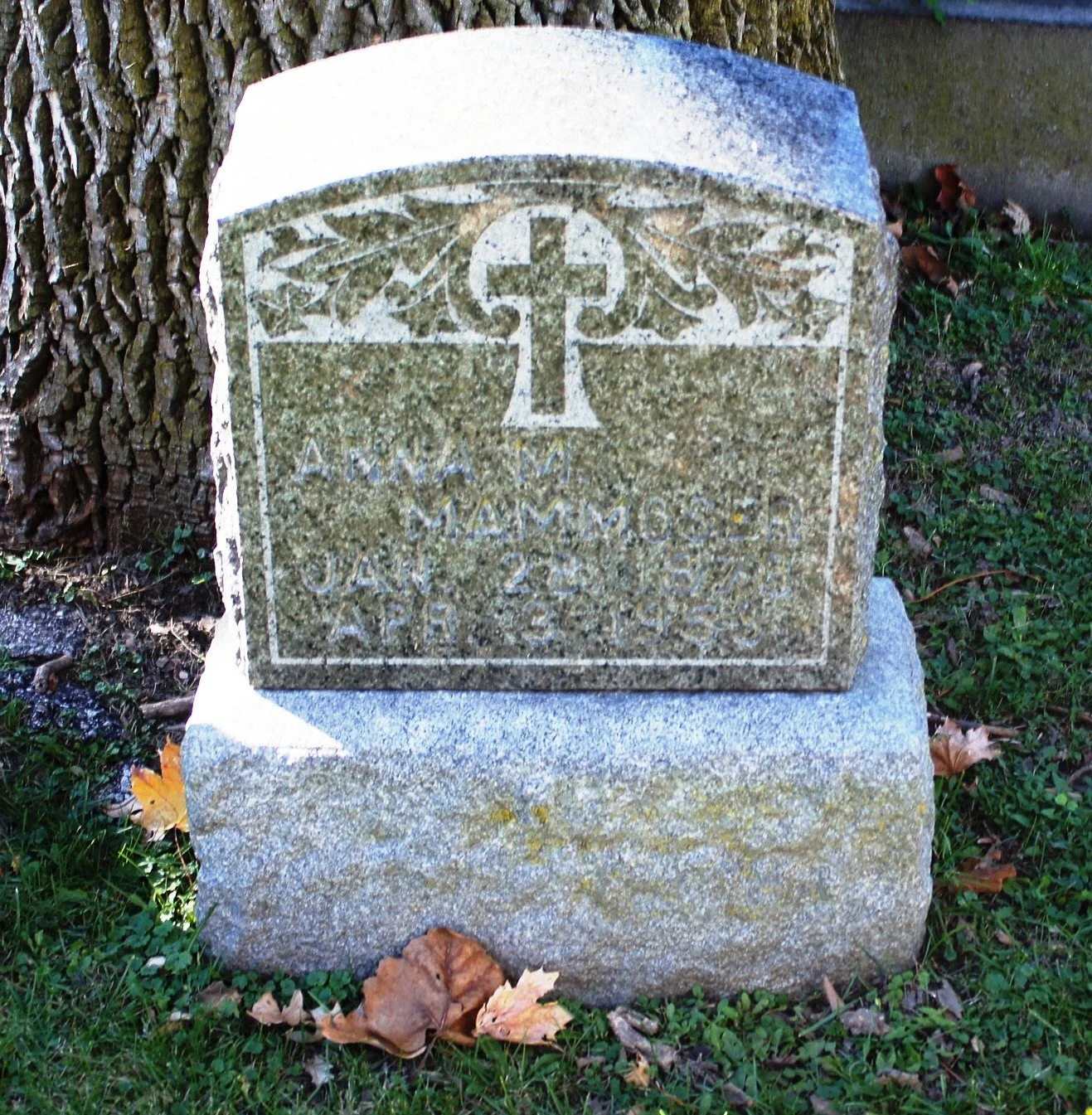
According to Find-A-Grave, Jacob Klaisner, his wife Anna, their daughter Anna and her husband Joseph Mammoser are all buried in Bohemian National Cemetery, Lot 16, Block 1, Section M.
FindAGrave.com, https://www.findagrave.com/memorial/256126547/jakub-klaisner, Memorial 256126547, maintained by RidgeRunner, added 3 Jul 2023 : downloaded 15 Feb 2026.